
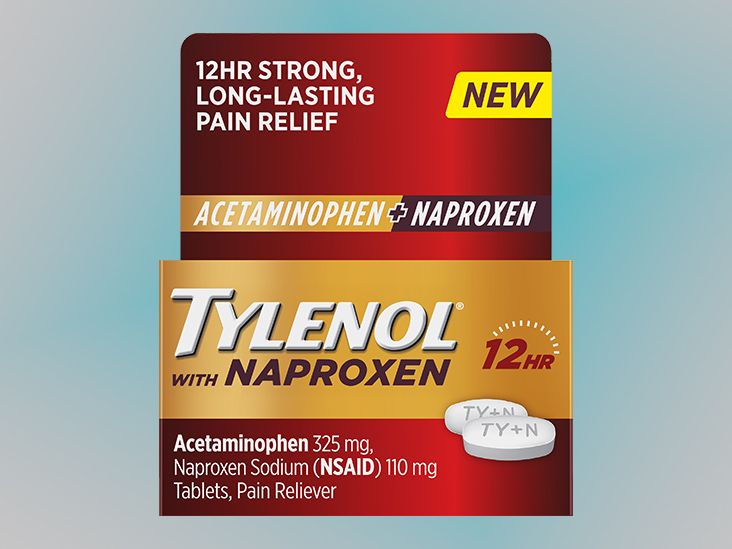
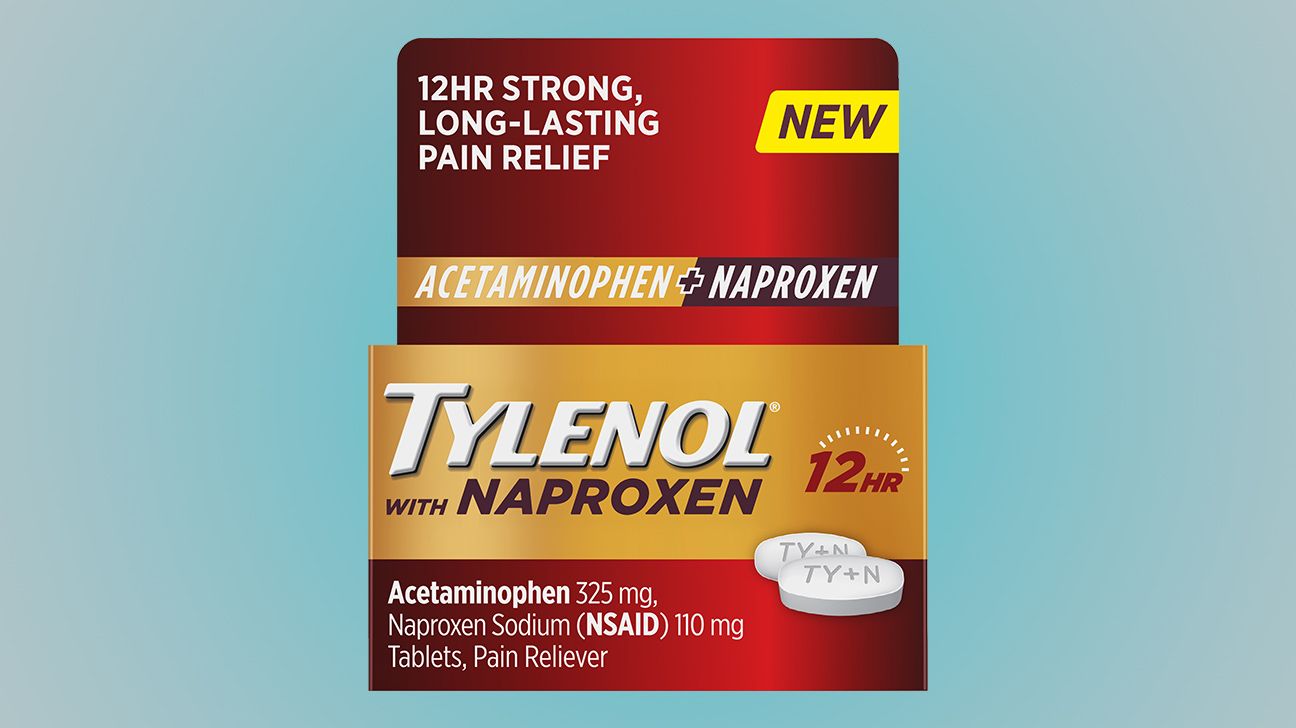
- Federal regulators have approved a new pain medication that combines the attributes of Tylenol and Aleve.
- The new product, Tylenol with Naproxen, is expected to be available soon as an over-the-counter medication in retail establishments across the United States.
- Advocates say the combination medication provides the fast-acting relief of Tylenol and the longer-lasting power of Aleve.
A new over-the-counter medication that combines the pain-relieving aspects of Tylenol and Aleve is heading to store shelves.
The Food and Drug Administration (FDA) has
Each tablet of Tylenol with Naproxen contains 325 milligrams (mg) of acetaminophen and 110 mg of naproxen sodium. Two tablets can be taken every 12 hours.
Kenvue, which manufactures Tylenol and Tylenol with Naproxen, said that Tylenol with Naproxen provides the fast-acting pain relief of acetaminophen along with the long-lasting effectiveness of naproxen sodium.
The company said the new drug starts working within 30 minutes and offers pain relief for up to 12 hours. Kenvue added that the new medication will soon be available at retailers across the United States.
Kenvue noted that eight clinical studies have demonstrated that Tylenol with Naproxen provides “superior pain relief” compared with acetaminophen or naproxen sodium alone.
The results of that research haven’t been published in a peer-reviewed journal yet, but the findings will be presented at PainWeek 2026 in Las Vegas in September.
“This milestone reflects the long-standing leadership of Tylenol in translating rigorous clinical science into accessible, over‑the‑counter solutions,” said Rajesh Mishra, MD, the chief medical officer at Kenvue, in a statement. “Persistent pain often leaves people trapped in a cycle of trial and error, navigating between choosing short-term relief or more complex treatment options.”
The FDA granted Kenvue a three-year period of exclusivity for its new over-the-counter formulation.
FDA officials said the new product is intended to be used for the “temporary relief of minor aches and pains due to headache, backache, muscular aches, toothache, menstrual cramps, and minor pain of arthritis in adults and children 12 years and older.”
The federal health agency noted that Tylenol with Naproxen is part of President Donald Trump’s program, The Great Healthcare Plan, to “make more verified safe pharmaceutical drugs available for over-the-counter purchase” to increase consumer choices and lower medication costs.
Kenvue said a survey conducted by the company in March 2026 found that 75% of people with persistent pain are dissatisfied with their current relief options.
They noted that the U.S. Department of Labor reports that up to 1 in 4 people prescribed opioids are at risk of addiction.
“Tylenol with Naproxen addresses this gap by combining two well-established non-opioid pain relievers into a single, clinically proven [over-the-counter] therapeutic solution that requires no prescription and carries no opioid risk,” Kenvue officials said in their statement.
There are some medication combinations now available for pain relief, but Tylenol with Naproxen is the first to combine acetaminophen with naproxen sodium.
Mixing the two medications is generally safe as long as dosing guidelines are followed.
Acetaminophen can cause liver damage if taken in high doses or over a long period of time. Naproxen can cause allergic reactions, skin reactions, and severe stomach bleeding in some people.
Additionally, the two pain-relief medications should not be taken with certain other prescription drugs, such as blood thinners. People who are pregnant should also consult with a doctor before taking these types of medications.
Sean Mackey, MD, a professor of anesthesiology, perioperative, and pain medicine at Stanford University, said that the new combination medication should be helpful, but its introduction isn’t groundbreaking.
“The combination is pharmacologically reasonable, but there is very little that is genuinely new here,” Mackey told Healthline. “Acetaminophen and naproxen have been available over the counter for decades, and patients and clinicians already use them together. The main innovation is convenience: putting two familiar drugs into one tablet.”
“I would not characterize this as an important advance in pain treatment,” Mackey added. “It is a sensible repackaging of two established medications. Its clinical value will depend on whether the convenience justifies the added cost and reduced dosing flexibility.”
Vernon Williams, MD, a sports neurologist, pain management specialist, and founding director of the Center for Sports Neurology and Pain Medicine at Cedars-Sinai Orthopaedics and Sports Medicine in Los Angeles, said his opinion of the new medication is “favorable with some caution.”
He said the new product combines two effective pain medications that work well together. He said the 12-hour effectiveness window also allows people to take fewer doses. He adds that the new product can also “provide an alternative to some opioid-based medications.”
However, Williams said he has concerns that people will feel they don’t need to follow safety precautions because the medication is sold over the counter.
He said people with persistent pain may take too much of the combination drug or take other medications, such as aspirin, along with it.
“They need to still follow proper procedures even though the drug is sold over the counter,” Williams told Healthline.
The Centers for Disease Control and Prevention (CDC)
Chronic pain rates increase with age, in particular in people 65 years and older. The prevalence is also higher in rural areas. Non-Hispanic American Indian and Alaska Native adults report the highest rates.
Pain is a sensation triggered by nervous system activation, often in response to actual or potential tissue damage.
Pain can be sharp, dull, burning or throbbing. It can be concentrated in one part of the body or widespread.
Pain is a subjective feeling. Some people have a high tolerance for pain while others don’t.
Identifying the type of pain can help determine treatment. Treating the underlying cause of pain is usually the preferred option.
Acute pain usually develops quickly and lasts for a short period of time. Chronic pain lasts for months or even years.
The treatment for pain varies greatly, depending on the type of pain and how severe it is.
Pain caused by an injury usually lessens as the injury heals. Many medical professionals prescribe the so-called RICE therapy of rest, ice, compression, and elevation.
Williams said the main thing for people to remember is that pain is an indication that there is an injury or illness somewhere in the body.
“They should view pain as a symptom. It’s a warning sign,” he said.
Williams said people can take medication to dull pain, but they should still get a diagnosis from a medical professional on what’s causing the pain.
He noted that chronic pain can produce other health issues, such as inflammation or sleep deprivation.
“You want to be sure you have an assessment done on your symptoms because they are a warning sign,” Williams said.
Leave a Reply