
Introduction and Objective: Digital health can improve outcomes for people with type 2 diabetes (T2D). Use of digital health tools, however, vary across patient populations. How health related social needs (HRSN) impact digital health use is largely unknown.Methods: Data from the 2022 Health Information National Trends Survey were analyzed to investigate the association between HRSN […]
Read MoreMonth: July 2025
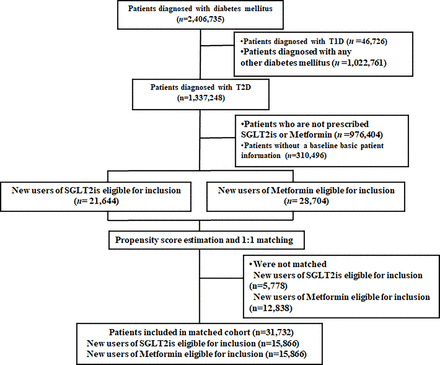
Risk of severe lower extremity arterial disease in elderly Japanese patients with type 2 diabetes: a propensity score-matched model analysis of sodium-glucose cotransporter 2 inhibitors versus metformin
Discussion Our study indicates that compared with metformin, SGLT2is may worsen severe LEAD in elderly patients with T2D, particularly those with low dBP. Revascularization is recommended in patients with LEAD based on their symptoms and Ankle-Brachial Index (ABI).19 A strong correlation between low dBP and abnormal ABI has been noted,20 21 with low dBP exacerbating […]
Read More83-OR: GLP-1RA Efficacy Doubled with Small Molecule Modulators of Pyruvate Kinase for Obesity Treatment
Introduction and Objective: To amplify insulin secretion from beta cells with nutrient-stimulated hormone (NuSH) receptor agonists (e.g., the GLP-1 RA liraglutide (LIRA)), mitochondria must be energized via substrate-driven ADP privation. Since small-molecule modulators of Pyruvate Kinase (mPK) energize mitochondria via the phosphoenolpyruvate cycle and further boost LIRA-amplified insulin secretion, we hypothesized that mPKs could also […]
Read More65-PUB: The Nomogram Development and Validation for Predicting Hypoxemia after Laparoscopic Sleeve Gastrectomy in Patients with Obesity—A Multicenter Retrospective Study
Introduction and Objective: Postoperative hypoxemia (PH) is the most common postoperative pulmonary complication (PPC) of bariatric surgery. However, clinically validated tools and tests are lacking to predict the risk of hypoxemia after bariatric surgery in patients with obesity. Therefore, this study developed and validated a nomogram model for predicting the probability of hypoxemia within 24 […]
Read More890-P: Efficacy of Antiobesity Agents on Fat Distribution—A Systematic Review and Network Meta-analysis of Randomized Controlled Trials
Introduction and Objective: Pharmacotherapy offers a potential solution for individuals with overweight and obesity to decrease their body weight. However, there is limited knowledge of the effects of anti-obesity agents on the distribution of body fat.Methods: The PubMed, Embase, and Cochrane Library databases were reviewed for randomized controlled trials (RCTs) of weight-lowering drugs between inception […]
Read More602-P: Extent and Impact of Provider Engagement with EHR-Based Diabetes Distress (DD) Screening
Introduction and Objective: ADA Standards of Care recommend screening for and addressing elevated DD, yet implementation is challenging. We built a validated, 8-item screener (T1-DDAS) into EPIC in the online e-CheckIn process for adults with T1D. A positive screen for DD (>= 2.0) generates a Best Practice Advisory (BPA) notification during the clinical encounter with […]
Read More1959-LB: Successful Nationwide Expansion of the Local Stuttgart Ketoacidosis Prevention Campaign in Germany—Which Parameters Are Important for Awareness Campaigns?
Introduction and Objective: Following the successful implementation of the Stuttgart Diabetic Ketoacidosis (DKA) Prevention Campaign at local level, we have extended this proven concept to the Federal State of Baden-Wuerttemberg (BW) in Germany.Methods: All public health departments (PHD) in BW were invited over 3 years to hand out flyers and posters about the typical symptoms […]
Read More601-P: Diabetes Self-Efficacy—Longitudinal Relationships with Diabetes Overall Self-Management, Medication Adherence, Diabetes Distress, and Glycemic Control in Adults with Type 2 Diabetes
Introduction and Objective: Self-efficacy and diabetes distress are inextricably linked to coping with diabetes. The role of diabetes distress in the relationship between diabetes self-efficacy and glycemic control in T2DM over time is understudied. The objective of this study was to evaluate the longitudinal associations of self-efficacy with overall diabetes self-management, medication adherence, diabetes distress, […]
Read More886-P: A Novel UCN2 Analog HM17321 with HM15275 Improves Body Composition in Mouse Model of Obesity
Introduction and Objective: Incretin drugs have demonstrated remarkable efficacy in body weight reduction and improving metabolic parameters. However, there may be challenges associated with lean mass loss and long-term health benefits. Urocortin-2 (UCN2) is a corticotropin-releasing factor receptor 2 (CRFR2) agonist and has been known to regulate whole body glucose metabolism, insulin sensitivity and skeletal […]
Read More524-P: Culturally Competent Diabetes Management—Addressing Access for Limited English Proficient Patients
Introduction and Objective: Diabetes affects all cultures, yet inequities persist, especially among minority groups who often receive lower-quality care. Language barriers lead to inadequate blood sugar control and reduced engagement in Diabetes Self-Management Education (DSME). This report evaluates the effectiveness of a DSME team in integrating culturally competent translated care into primary care, enhancing services […]
Read More