
Introduction and Objective:GLP1R R131Q (rs3765467) has been reported as a type 2 diabetes protective variant in genome-wide association studies and glucagon-like peptide-1 receptor (GLP1R) activation has been shown to have various β cell protective effects. We hypothesized that the variant induces a gain-of-function change enhancing the β cell protective effects mediated by GLP1R activation.Methods: We […]
Read MoreMonth: July 2025

Ultra-Processed Foods Directly Linked to Chronic Diseases
Share on PinterestResearchers say there is strong evidence showing that ultra-processed foods promote overeating and increase the risk of obesity. Helene Cyr/Stocksy United A new report states that ultra-processed foods are a major contributing factor to the obesity epidemic. Researchers say these foods are designed to be palatable, causing people to overeat and gain weight. […]
Read More663-P: Associations between Relationship Status and Parenting on Glycemic and Emotional Outcomes in Adults with Type 1 Diabetes (T1D) Enrolled in the GluCog Study
Introduction and Objective: Prior research has shown a link between marital quality and HbA1c in adults with T1D, however, little is known about how parenting impacts glycemic control, including CGM metrics. The aim of the current study was to investigate whether relationship and parenting status impact glycemic outcomes in adults with T1D. Emotional distress was […]
Read More847-P: ASC47, a Muscle-Preserving Weight Loss Drug Candidate for Obesity, in Combination with Semaglutide, Demonstrated Superior Weight Loss to Semaglutide Monotherapy in a Preclinical Model
Introduction and Objective: ASC47 (selective THR-β agonist) is an adipose-targeted, once-monthly subcutaneously (SQ) injected, muscle-preserving weight loss drug candidate for the treatment of obesity, discovered and developed in-house at Ascletis. This study in diet-induced obese (DIO) mice demonstrated a powerful synergy in weight loss and muscle preservation when combining ASC47 and semaglutide.Methods: C57BL/6J mice were […]
Read More662-P: Diabetes Distress, Management, and Psychosocial Needs among Black Young Adults with Type 1 Diabetes from Two Health Care Systems—An Integrated Care System and Public Safety-Net Hospital?
Introduction and Objective: Private integrated healthcare and public safety-net care systems address the medical needs of different socioeconomic (SES) status groups. Irrespective of SES, many young adults with T1D struggle with diabetes management. The study evaluated survey data of Black young adults with T1D in two different healthcare systems to understand psychosocial factors, diabetes care […]
Read More844-P: Association between Preoperative GLP-1RA Use and Postoperative Respiratory Complications in Real-World Patients Undergoing Elective Surgical Procedures—A Target Trial Emulation Study
Introduction and Objective: There have been growing concerns about GLP-1 RA use and the risk of aspiration pneumonia. Mixed results exist regarding aspiration pneumonia risk with perioperative GLP-1 RA use, with limited focus on elective surgical procedures. Therefore, we assessed the association between preoperative GLP-1 RA use and postoperative respiratory complications in patients undergoing elective […]
Read More661-P: Comparative Analysis of Physical Activity and Dietary Behavior between Prediabetes and Normoglycemic Population
Introduction and Objective: Prediabetes (preDM) among adults is on the rise, physical activity (PA) and healthy diet as modifiable lifestyle influencing factors can help prevent or delay progression to type 2 diabetes in adults with preDM, but it is unclear whether these factors vary by prediabetic status.Methods: Cross-sectional study of Chines adults without DM who […]
Read More
Introduction and methodology: Standards of Care in Overweight and Obesity—2025
Collaborators: Collaborator group name: ADA Professional Practice Committee (PPC). Individual names (in order): Nuha A ElSayed, Vanita R Aroda, Louis J Aronne, Kirthikaa Balapattabi, Allison K Bennett, Sathyavathi Challa Siva Kanaka, Kathaleen Briggs Early, Angela Fitch, Stephanie L Fitzpatrick, W Timothy Garvey, Kimberly A Gudzune, Scott Kahan, Kamlesh Khunti, Robert F Kushner, Elizabeth J Pekas, […]
Read More298-OR: Reducing Diabetes Distress Leads to Positive Glycemic Change—Results from the EMBARK Trial
Introduction and Objective: We asked how a diabetes distress (DD) intervention fostered changes in diabetes-related emotion management, diabetes problem solving, and HbA1C; and to test a hypothesized 4-Stage, sequential pathway whereby reductions in DD were linked with improved glycemic outcomes.Methods: PWDs with T1D (n=276) with elevated DD and HbA1cwere assigned to: StreamLine, a diabetes self-management […]
Read More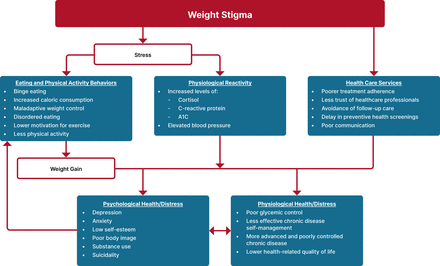
Weight stigma and bias: standards of care in overweight and obesity—2025
Introduction People living with obesity face negative attitudes, stereotypes, and blame from others because of their weight (ie, weight bias).1 Weight bias can be explicit, such that an individual is conscious of negative attitudes (ie, blatant), or it can be implicit, where the person is unwilling or unable to admit these attitudes (ie, unconscious).2 Weight […]
Read More