
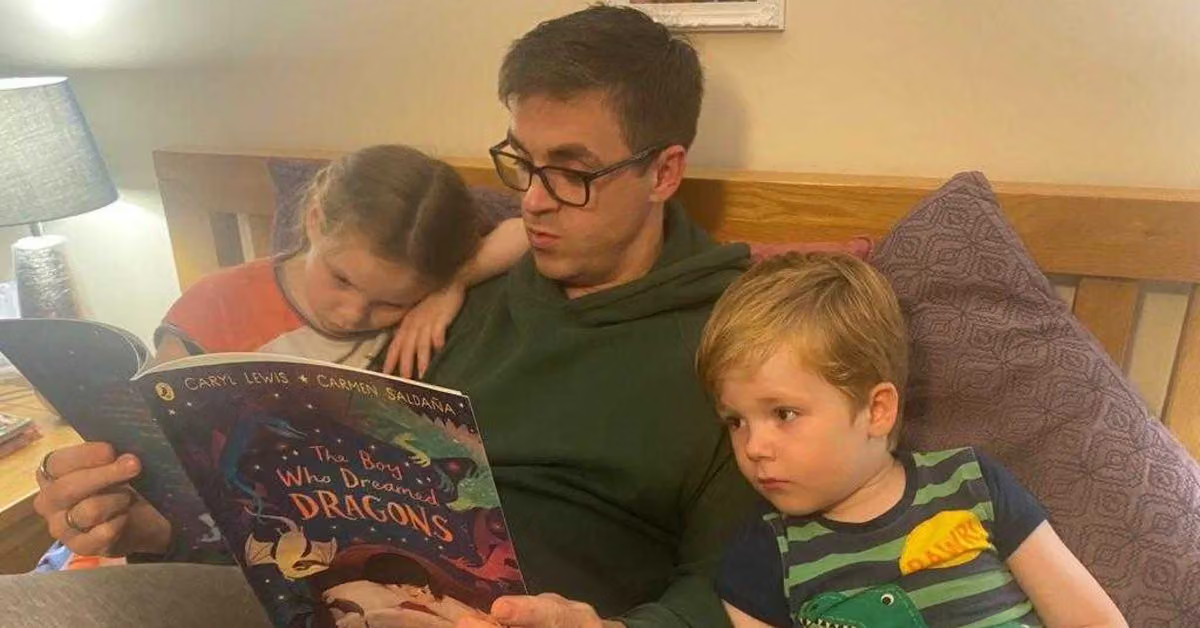
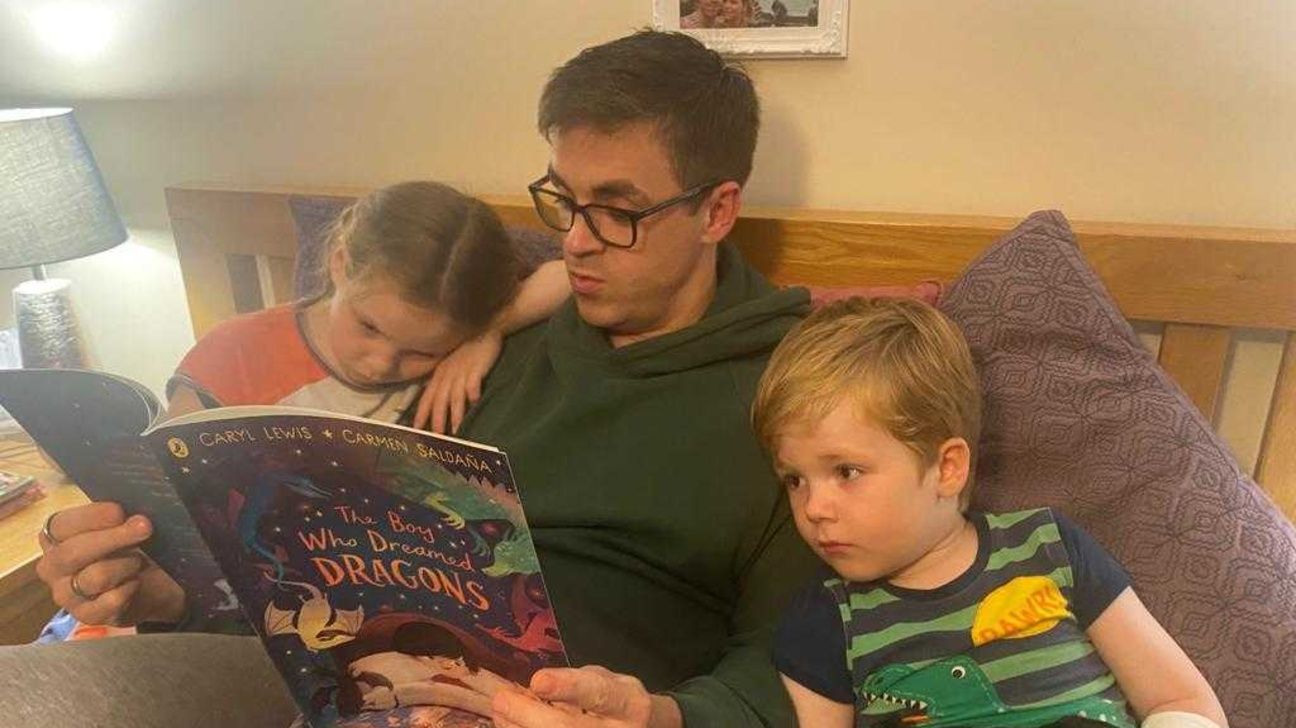
- October is Health Literacy Month: a reminder that even the best health information only helps if people can read it and understand it. That’s what the Healthline Editorial team works toward every day, but literacy starts much earlier: with a child, a bedtime, and a book.
- Research links regular reading for pleasure to better mental health, a lower risk of cognitive decline in older adults, and healthier habits in kids, including less screen time.
- Healthline’s Editor-in-Chief Robin Hough shares how nightly bedtime reading with his two kids, from “Harry Potter” to “The Lord of the Rings,” became a ritual that’s healthy for all three of them, and why reading deserves a place alongside nutrition, sleep and exercise as a building block of well-being.
I’ve read to my children each night at bedtime for as long as I (and they) can remember. We started with the likes of “Goodnight Batcave” and the lesser-known-in-the-US but oh-so-wonderful collection of verse-driven classics from former UK Children’s Laureate Julia Donaldson.
We moved on to B.J. Novak’s anarchic love letter to the power of words (and to great typography), “The Book With No Pictures.”
We eventually worked our way up to Roald Dahl’s wickedly dark back catalog, discovering more complex characters, language and plotting as we went.
When my eldest, Amelia, hit 6, it was time to roll out the big guns.
Over the last 5 years (she’s now 11), I’ve read the seven Harry Potter books aloud twice, complete with all the voices: once to Amelia on her own, once to both her and her brother, Henry, two years her junior.
I had feared she wouldn’t be keen on another helping, but Amelia immersed herself once more in the world of Hogwarts with no hesitation and took immense joy in watching Henry discover for himself every twist and turn on Harry’s journey.
We have done the same thing with Tolkien’s “The Hobbit” and his fantasy masterpiece “The Lord of the Rings,” and are currently midway through “The Two Towers” on our second go around.
There’s a huge amount of reciprocal joy we take from this nightly ritual, beyond the practical benefits of providing a calming demarcation between the end of the day and the wind-down to sleep.
For me, it comes as either a break in my working day or a signal that it’s over, depending on how hectic things are.
For the kids, it’s an all-too-rare chance to get me all to themselves, no deadlines, screens, or other distractions to pull me away from being anything but 100% present.
For all three of us, it’s a literal (and literary!) warm blanket — a chance to escape under the covers to familiar worlds and familiar faces. It is, in short, incredibly good for our well-being.
And yet, in the world of health information — including on this site — thousands, if not millions, of reading hours are dedicated to the benefits of nutrition, sleep, and exercise as the building blocks of good health. Reading itself rarely makes that shortlist.
For me, it unequivocally deserves a place on it. Research seems to support that case. Even if we need more of it to really understand how and why.
A recent editorial in Psychological Medicine co-authored by Barbara Sahakian, Professor of Clinical Neuropsychology at Cambridge University, draws on a broad range of research linking reading for pleasure to better mental health and greater empathy.
“Reading is a great way to support our brain health, develop important cognitive skills and boost our wellbeing. It’s something we ought to be encouraging from an early age, given the increasing evidence of its benefits, particularly to children, but really, it’s never too late to start, and it can bring benefits throughout our lives and into old age,” Barbara Sahakian, Professor of Clinical Neuropsychology, Cambridge University
The positive impact of reading on young people — just like Amelia and Henry — lso carries evidence.
Among more than 10,000 US adolescents, those who started reading for pleasure early had fewer mental health problems, spent less time on screens and slept more. Although, per an earlier column of mine, I can’t vouch for the sleep side of things when it comes to early bird Henry.
For many, reading can be a form of therapy that improves well-being. Bibliotherapy is a complementary therapeutic tool for emotional release and reduced stress and anxiety, with its roots traced back to ancient civilizations.
A separate
A happy (and healthy) by-product of this love of being read to is that both my kids have now started reading to me at bedtime. Henry recently read “Jeffy the Burglar’s Cat” to us, a lesser-known but no less compelling chapter book by Ursula Moray Williams that was a staple of my own childhood. And we’ve enjoyed several books from Amelia, including the wistful tale of friendship and the circle of life, “Charlotte’s Web” by E.B. White – not a dry eye in the house for the final few chapters of that one.
They’ve also gone off and re-read the Harry Potter books and “The Hobbit” to themselves.
The research above links reading to many health benefits: better attention and memory, fewer mental health problems, more sleep, less time on screens, and greater empathy. I haven’t measured any of those impacts empirically in our house. Nor am I naive to the fact that as they get older, they’ll ultimately grow out of me reading to them, with school, extracurricular activities, their friends, and inevitably screens competing for more and more of their time.
Come what may, though, I know that a child who considers missing a reading session as the most cardinal of cardinal sins, and who scrambles for the chance to read aloud to their dad at bedtime is, at that moment, concentrating, empathizing, discovering and growing.
Regardless, it’s a healthy habit Amelia, Henry and I are very happy to keep, and with a bit of luck, I’ll get to pass it on to their kids one day.
A list of recommended bedtime reads for you and your loved ones:
- “Room on the Broom,” Julia Donaldson. An early-years classic with lyrical verse, Axel Scheffler’s beautiful illustrations, and a fire-breathing red dragon who meets his match in a witch and her band of animal friends.
- “Goodnight Batcave,” Dave Croatto. A glorious Batman-inspired parody of Goodnight Moon from the folks at MAD Magazine.
- “The Book With No Pictures,” B.J. Novak. A ridiculous-and-hilarious-in-equal-measure read-aloud classic for language lovers of all ages.
- “The Witches,” Roald Dahl. Hard to choose one from Dahl’s delicious macabre oeuvre, but this twisted tale of a boy-turned-mouse and his cigar-smoking, witch-hunting Grandma takes the cheese by a whisker.
- “Jeffy the Burglar’s Cat,” Ursula Moray Williams. A lesser-known classic from my own childhood that Henry recently read to both of us.
- “Charlotte’s Web,” E.B. White. A tale of friendship, loss and the circle of life, set in a barnyard, that Amelia read to me.
- “Harry Potter” (1-7), J.K. Rowling. A modern-day magical classic that inspired a generation of readers across the globe, including my two Potter-obsessed kids.
- “The Hobbit,” J.R.R. Tolkien. A more child-friendly introduction to Middle-earth and its timeless characters, including Gandalf, Bilbo and Gollum.
- “The Lord of the Rings,” J.R.R. Tolkien. YOU SHALL NOT PASS up the chance to read the father of modern fantasy. The films are pretty incredible too.
Robin Hough is the Editor-in-Chief of Healthline, and in addition to this regular Letter from the Editor column, he can be found every other Wednesday in our Healthline Wellness Wire newsletter.
Leave a Reply