Share on PinterestDrinking coffee black without cream or sugar could help reduce your risk of death from cardiovascular disease. Getty Images/Kseniya Ovchinnikova Researchers say daily coffee consumption can lower a person’s overall mortality risk as well as their risk of death from cardiovascular disease. However, the benefits decline for those who add significant amounts of […]
Read MoreAuthor: sugaradmin

Can GLP-1 Drugs Actually Make Your Penis Larger?
Share on PinterestA growing number of males on Reddit are claiming that GLP-1 drugs have increased their penis size. Kupicoo/Getty Images Male Reddit users are reporting what they call “Ozempic penis,” with some claiming penile growth of up to 1.5 inches. Experts say, however, that Ozempic penis is not a true side effect of GLP-1 […]
Read MoreFDA Approves Highly Effective, Twice-Yearly Shot for Prevention
Share on PinterestYeztugo is a twice-yearly injection to prevent HIV that could improve adherence rates compared to other PrEP medications. d3sign/Getty Images The FDA has approved lenacapvir, a twice-yearly injection to prevent HIV infection that could improve adherence rates compared to other PrEP medications. The drug, which will be sold under the brand name Yeztugo, […]
Read MoreFasting plasma glucose outperformed 1-hour plasma glucose in predicting diabetes incidence in individuals with family history of young-onset type 2 diabetes
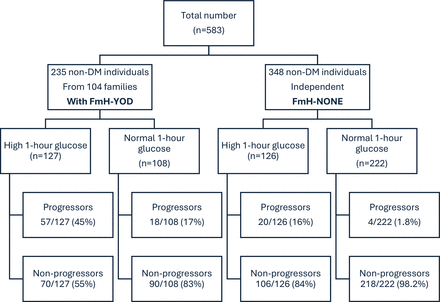
Results From the original cohort of 477 siblings in the HKFDS and 863 presumably unrelated individuals in the BHBHK, 583 individuals were included in the present analysis, of whom 235 individuals from 104 families had a FmH-YOD and 348 unrelated individuals reported no FmH of diabetes (FmH-NONE) (figure 1 and online supplemental figure 1). In […]
Read MoreNovel Cell-to-Cell Communications Between Macrophages and Fibroblasts Regulate Obesity-Induced Adipose Tissue Fibrosis
Recent evidence has shown that adipose tissue eventually develops fibrosis through complex cellular cross talk. Although advances in single-cell transcriptomics have provided new insights into cell diversity during this process, little is known about the interactions among the distinct cell types. In this study, we used single-cell analytical approaches to investigate cell-to-cell communications between macrophages […]
Read MoreDA-1241, a GPR119 Agonist, Ameliorates Fatty Liver Through the Upregulation of TFEB-Mediated Autophagy
G protein–coupled receptor 119 (GPR119) is predominantly expressed in pancreatic β-cells, enteroendocrine cells, and the liver. It is a novel therapeutic for dyslipidemia and type 2 diabetes. DA-1241, a GPR119 agonist, improves glucose tolerance by inhibiting gluconeogenesis and enhancing insulin secretion. It mitigates hepatic inflammation by inhibiting NFκB signaling. However, the mechanism by which DA-1241 […]
Read MoreA Randomized Controlled, Double-Masked, Crossover Study of a GPR119 Agonist on Glucagon Counterregulation During Hypoglycemia in Type 1 Diabetes
Activation of GPR119 receptors, expressed on enteroendocrine and pancreatic islet cells, augments glucagon counterregulatory responses to hypoglycemia in preclinical models. We hypothesized that MBX-2982, a GPR119 agonist, would augment counterregulatory responses to experimental hypoglycemia in participants with type 1 diabetes (T1D). To assess this, we designed a phase 2a, double-masked, crossover trial in 18 participants […]
Read MoreThe Disposition Index in Autoantibody-Positive Individuals at Risk for Type 1 Diabetes
Since little is known about the disposition index (DI) in autoantibody-positive individuals, we have assessed whether DI has a similar association between insulin secretion and sensitivity to the association observed in other populations. In TrialNet Pathway to Prevention (TNPTP; n = 6,620) and Diabetes Prevention Trial–Type 1 (DPT-1; n = 704) study participants, two secretion-sensitivity […]
Read MoreSurface Modification of Islets With L-DOPA–KF7 Enhances Islet Survival by Inhibiting IBMIR in Intrahepatic Islet Transplantation
Intrahepatic islet transplantation is followed by islet loss due to the instant blood-mediated inflammatory response (IBMIR) in which platelet activation plays a key role. The KEATSTF-fragment (KF7), a newly discovered platelet inhibitor that interferes with the formation of the 14-3-3ζ–c-Src–integrin-β3 complex, holds significant potential in inhibiting IBMIR without causing significant bleeding. This study introduces a […]
Read MoreAre Polymorphisms Within the Fructosamine-3-Kinase Gene Associated With the Discordance Between HbA 1c and Other Measures of Glycemia?
Glycated hemoglobin has shown disagreements with other glycemic indices; termed the glycation gap. The glycation gap can be influenced by nonglycemic factors, such as protein deglycation, through the fructosamine-3-kinase (FN3K) enzyme. This cross-sectional study aimed to examine whether single nucleotide polymorphisms (SNPs) in the FN3K gene can explain the glycation gap. Among the 826 participants, […]
Read More