
Discussion
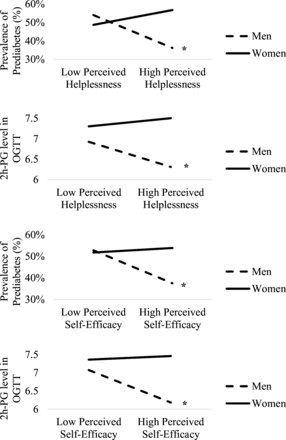
Understanding the associations between perceived stress and glycemic measures—and how these associations vary by gender and age—is important for developing targeted strategies to prevent the onset and progression of prediabetes. In our study, higher levels of both perceived helplessness and perceived self-efficacy were associated with a lower prevalence of prediabetes and lower 2h-PG levels among men. A similar pattern was observed among older women, with higher perceived helplessness linked to lower 2h-PG levels. In contrast, among younger women, higher perceived helplessness was associated with a higher prevalence of prediabetes and elevated 2h-PG levels.
Although previous studies have highlighted the negative consequences of perceived helplessness, such as poorer health outcomes,25 online game addiction,33 and heightened anxiety and depression,34 our findings suggest that perceived helplessness is associated with lower prediabetes prevalence and reduced 2h-PG levels. This finding aligns with prior research showing that higher work stress is linked to a reduced risk of type 2 diabetes in men, but not in women.12 A similar pattern emerged among older women (aged 62–74 years), for whom higher perceived helplessness was also associated with lower 2h-PG levels. One possible explanation is that perceived helplessness may prompt greater engagement in adaptive coping behaviors, such as physical activity. Supporting this notion, prior research has found that among older adults, the number of stressors is positively associated with engagement in physical activity.35 Thus, in older individuals, perceived helplessness may act as a motivational cue, regardless of gender, encouraging health-promoting behaviors that help regulate glucose levels.
Our findings contribute to the literature on gender differences in stress-related health outcomes by clarifying how specific stress components interact with age to influence glycemic regulation in women. Previous studies have reported that increased work stress is associated with a higher risk of type 2 diabetes in women but not in men,11 12 with explanations pointing to women’s greater physiological reactivity to stress, such as elevated cortisol levels.12 Extending this work, we found that perceived helplessness, but not perceived self-efficacy, was significantly associated with higher prediabetes prevalence and elevated 2h-PG levels among younger women. This suggests that younger women may be more susceptible to the detrimental effects of perceived helplessness than to the protective effects of perceived self-efficacy. One possible explanation involves hormonal fluctuations across the menstrual cycle, which have been shown to increase stress sensitivity. For instance, stress reactivity intensifies during the luteal phase,36 and younger women exhibit stronger negative responses to a stressful task assignment during the premenstrual phase.37 Taken together, these findings highlight the importance of accounting for both age and the nature of stress perceptions when investigating gender-specific pathways to glycemic dysregulation, and they point to potential boundary conditions for the adverse effects of stress observed in prior research on women’s health.
One explanation for the stronger adverse associations between perceived helplessness and glycemic outcomes among younger women, as shown in our research, is that their stress may be less effectively buffered by social support. Relatedly, previous research has demonstrated a significant association between poor social support and 2h post-OGTT glucose levels among women.38 Although social support was not directly assessed in our study, both gendered roles and life stages are likely to influence access to support networks. In Singapore, cultural norms place a disproportionate caregiving burden on women.39 Younger women may therefore receive inadequate support while simultaneously managing the demands of an early career and caregiving responsibilities, such as childcare and eldercare. By contrast, older women often have more established social networks and have fewer childcare concerns as they age. Consequently, younger women may be more vulnerable to the adverse physiological consequences of stress than men or older women.
We also found significant associations between perceived stress and glycemic outcomes when using prediabetes status and 2h-PG levels as outcome variables, but not when using FPG or HbA1c. These measures capture different aspects of glucose metabolism and may reflect gender differences in metabolic responses to stress. Research indicates that men, under stress, use blood glucose more efficiently than women, achieving a higher glucose influx rate—the rate at which glucose is transported from the bloodstream into cells for energy use.40 This dynamic process is better captured by the 2h-PG, which reflects the body’s capacity to manage a glucose load and how effectively glucose is taken up by peripheral tissues such as muscle. In contrast, FPG and HbA1c reflect more static or chronic aspects of glucose regulation: FPG is influenced by hepatic glucose output and insulin function during fasting, while HbA1c indicates average glucose levels over the past 2–3 months. The OGTT, from which 2h-PG is derived, provides a more sensitive and dynamic assessment of glucose regulation and is particularly useful for detecting prediabetes and predicting type 2 diabetes risk.41 Notably, few psychological stress studies incorporate OGTT due to its time and cost demands, making its inclusion a strength of our study. This is especially relevant in a diabetes-free population, where OGTT can reveal early dysregulation not detectable by FPG or HbA1c, helping to uncover stress-glucose associations that may be overlooked in prior research.
Moreover, our findings suggest that gender-specific interventions incorporating psychosocial strategies and lifestyle modifications for diabetes prevention may be beneficial. Prior research highlights gender differences in stress-related behaviors: men are more likely to engage in physical activity to cope with stress,42 whereas women tend to consume more unhealthy food,43 and poor diet quality is more strongly linked to prediabetes risk in women than in men.44 Future studies could include behavioral measures, such as exercise frequency and unhealthy food intake, to examine how these behaviors mediate the relationship between perceived stress and glycemic regulation, thereby informing more effective interventions.
Our age-specific findings add nuance to the stress-glycemia link. That only perceived helplessness relates to glycemic outcomes in younger women suggests emotional distress may be more influential than self-efficacy in this group. A recent survey found that stress levels have risen, particularly among younger women,45 underscoring the need to target helplessness in stress-reduction efforts. Future research could explore strategies such as reframing distress as a sign of passion.46
Limitations and future research directions
Several limitations of our study point to avenues for future research. First, the cross-sectional design limits causal inference and may inflate associations due to the temporal proximity of measures. However, we mitigated this concern by using distinct types of measures—self-reported stress as predictors and biological indices as outcomes.47 Future studies could adopt longitudinal designs to clarify the directionality of the observed associations.
Second, participants’ perceived helplessness levels were mostly within the low-to-moderate range on a 5-point scale (1=never, 2=almost never, 3=sometimes; 25th percentile=1.83, median=2.33, 75th percentile=2.83). Prior research suggests that moderate stress may lower blood glucose, whereas extremely high stress may elevate it.48 This may explain the inverse association between perceived helplessness and glycemic measures observed in men. Future research could examine whether moderate and high levels of perceived helplessness differentially affect glycemic outcomes.
Third, we assessed participants’ stress using self-reported ratings, which may be subject to bias. For instance, participants might under-report their stress levels to maintain a positive self-image or to conform to social desirability norms. Our findings may also reflect reference bias,49 in which individuals evaluate the same item against differing implicit standards. For example, males and females may adopt different benchmarks for what qualifies as ‘stressful’, potentially leading to divergent associations between self-reported stress and specific outcome variables. To strengthen validity, future studies could incorporate biological measures of stress (eg, cortisol tests) to examine the replicability of the present findings.
Fourth, our data were collected during the COVID-19 pandemic and exclusively from a Singaporean sample. Stress and social dynamics were atypical in 2020–2021 owing to lockdowns, remote working, and other pandemic-related disruptions. As such, the present findings might reflect the characteristics of this sample, including its demographic composition, cultural context, and the unique timing of data collection. These factors might have influenced the observed associations between stress and glycemia. To strengthen the generalizability of these results, future research could examine postpandemic populations and include samples from diverse cultural settings.
Finally, our findings underscore the importance of identifying potential mediators linking perceived stress to glycemic regulation. For instance, gender differences in metabolic responses to stress or hormonal fluctuations across phases of the menstrual cycle in women warrant further investigation. Although both perceived helplessness and perceived self-efficacy were associated with lower 2h-PG levels in men, these associations may operate through distinct mechanisms. For example, perceived helplessness might reduce appetite, whereas perceived self-efficacy may promote engagement in physical activity. Future research should examine these behavioral and physiological pathways to clarify how different components of perceived stress influence glucose metabolism.
Leave a Reply