
Discussion
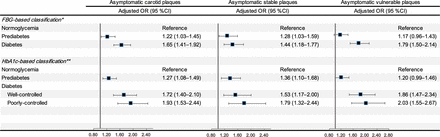
In this large, community-based, cross-sectional study, we found that patients with pre-diabetes or diabetes had an increased prevalence of asymptomatic carotid plaques. This association remained significant even after adjusting for age, sex, and other traditional risk factors. Compared with normoglycemic subjects, in multivariate analyses, individuals with pre-diabetes and those with diabetes had higher odds of asymptomatic carotid plaques. However, only diabetes was observed to be associated with increased odds of vulnerable plaques. Further analysis of diabetes status based on different HbA1c levels showed similar results. Poorly controlled diabetes had the highest odds of the presence of carotid plaques, stable plaques, and especially vulnerable plaques. We did not find a significant association between diabetes and abnormal CIMT in this study.
Previous studies have elicited a controversial relationship between diabetes and asymptomatic carotid atherosclerosis. A few studies focusing on risk factors of asymptomatic carotid artery stenosis found that diabetes was one of the predictors for moderate stenosis (>50%), with an OR of 1.3 (95% CI 1.0 to 1.8), as well as severe stenosis, with an OR of 1.6 (95% CI 1.0 to 2.5).5 25 Diabetes has been included in several risk models for predicting asymptomatic carotid artery stenosis.26 The Atherosclerosis Risk in Communities (ARIC) study showed that diabetes could predict CIMT progression.27 Data from the Jackson Heart Study showed that a 1% increment in HbA1c or 0.56 mmol/L increase in FBG level was associated with higher odds of abnormal CIMT.28 However, the association between diabetes and total plaque area, or CIMT, or their progression was not verified in the Tromsø study.29 The Progression of Early Subclinical Atherosclerosis (PESA) study revealed no association between diabetes and carotid plaque burden.30 On the other hand, a previous Korean study showed that diabetes was a predictor of carotid plaque development, and that high-risk plaques evaluated by carotid ultrasound showed association with HbA1c level.31 Furthermore, the SPREDIA-2 study on 1475 subjects showed that glycemic status (pre-diabetes, newly diagnosed diabetes, and previous established diabetes) was significantly associated with the prevalence of carotid plaques in the multivariate analysis, which is consistent with our results. However, in contrast to our results, another study found that glycemic status was significantly associated with both the mean common CIMT and maximum CIMT.12 Nonetheless, they did not analyze the control status of diabetes or plaque stability.
In contrast, a study on subjects over the age of 40 years evaluated IMT of 12 segments of plaque-free carotid arteries and found that diabetes was not an independent predictor of CIMT.32 Furthermore, another case–control study with a 7-year follow-up showed that although the carotid total plaque value was significantly greater in subjects with type 2 diabetes or impaired glucose tolerance than in those with normoglycemia, no significant difference was found in the mean CIMT between the two groups.7 Regardless of similar results to us, the aforementioned studies did not analyze the effect of different diabetes status on asymptomatic carotid atherosclerosis.
In addition, our study showed that diabetes increased the risk of vulnerable plaques. Previous studies have demonstrated that dynamic changes in inflammation acted as an important factor in the development of atherosclerosis in patients with diabetes. It has been accepted that multifactorial intensive intervention can reduce low-grade systemic inflammation and delay the occurrence of atherosclerosis in patients with short-duration type 2 diabetes.33 Enhanced vascular smooth muscle cell apoptosis may contribute to the progression of plaques in diabetes towards instability by increasing production of proinflammatory cytokines, making diabetes-associated plaques more prone to inflammation-dependent rupture, thereby increasing the risk of ischemic cerebrovascular events. The intriguing and novel proatherogenic mechanism of apoptosis in human diabetes was also found to be strongly correlated with the intensity of glycemic control, as reflected by HbA1c, supporting the role of glycemic control in plaque stabilization in patients with diabetes and atherosclerotic disease.34 The above-stated findings are similar to the results of our study showing that poorly controlled diabetes carries a higher risk of asymptomatic carotid plaque, especially vulnerable plaques.
Exploring the relationship between abnormal glucose metabolism and carotid atherosclerosis is vital for slowing down the progression speed of atherosclerosis and primary prevention of stroke. At present, carotid ultrasound remains an attractive, non-invasive method to detect carotid atherosclerosis, monitor atherosclerotic progression, and evaluate treatment response. A previous review on atherosclerosis showed that effective glycemic control, especially in earlier stages of the disease, attenuated the progression of structural markers, such as increased intima–media thickness and coronary artery calcification.35 Implementing effective strategies to achieve ideal glycemic control is crucial for achieving clinical benefit in patients with carotid atherosclerosis. Patients with diabetes have increased both the susceptibility to atherosclerosis and the prevalence of atherogenic risk factors, notably hypertension and dyslipidemia. Implementing a multimodality approach for diabetes treatment is feasible and efficacious in decelerating the progression of subclinical arterial damage in routine clinical practice.36 It is imperative to give timely and optimal medical therapy to patients with diabetes.
Despite its merits, this study had some limitations which need to be considered. First, this study did not recruit a nationally representative sample. Thus, the results cannot be generalized to the entire Chinese population or to other racial groups. Second, although our study revealed the association between different diabetes status and asymptomatic carotid atherosclerosis, further longitudinal investigations are needed to explore the effects of different glucose metabolism parameters on the change of carotid atherosclerosis and confirm the causality. Third, we were unable to examine the impact of various medications, such as lipid-lowering therapy, on the relationship between different diabetes status and carotid atherosclerosis due to the lack of separate records of past medication history. Fourth, we will evaluate the characteristics of plaque in more detail and explore which signs of unstable plaques correlate with diabetes. As a community-based study on rural Chinese adults for the stroke screen survey, CIMT was analyzed dichotomously. Future studies incorporating continuous measurements are needed to provide complementary insights into early subclinical changes.
Leave a Reply