
Discussion
In line with previous meta-analysis,23 we found that DXA-derived z-scores of BMD were approximately 0.5 SDS lower across different measurement sites in adolescents with poorly controlled T1D than in the reference population. In contrast to most previous studies,23 in our cohort of adolescents with T1D, this finding was apparent particularly in boys. The reason for this difference between the sexes in our cohort is unclear. However, it may reflect a complex interplay of biological and developmental factors in boys with poor glycemic control or behavioral factors that have not been captured by our assessments. Despite lowered BMD in our cohort, we did not find any statistically significant associations between markers of long-term dysglycemia (total exposure of the body to high blood glucose levels over time), HbA1c or CGM parameters and measures of bone health at baseline or during follow-up. This finding may seem unexpected as diabetes duration and dysglycemia have been reported to associate with fracture rate in adults.24 However, previous studies have provided mixed results on the effect of glycemic burden on skeletal health and in a recent meta-analysis of skeletal health in youth with T1D, no association between diabetes duration or HbA1c and DXA-measured BMD was found.23 While DXA is a widely used tool for assessing BMD, it provides only areal measurements and lacks sensitivity to important aspects of bone quality, such as microarchitecture and direct measures of cortical and trabecular bone compartments. The use of DXA may have limited the ability to detect subtle or compartment-specific skeletal changes related to poor glycemic control. As metabolically active trabecular bone may be particularly sensitive to the effects of chronic hyperglycemia,14 and vertebral bodies are particularly rich in trabecular bone, we also investigated vertebral morphology in our cohort, which has not been studied before in youth with T1D, to the best of our knowledge. We found no compression fractures, which are well-established markers of osteoporosis and advanced skeletal fragility. This finding is in line with previous reports on a large national cohort from the UK showing no increase in fracture rate in children or young adults with T1D.25
The mechanism by which T1D impairs bone mineral accrual and in the longer term results in skeletal fragility is somewhat poorly defined. Standard glycemic metrics, such as HbA1c or glucose variability, appear to be insufficient surrogate markers of bone mineral accrual in youth with T1D. There is an evident need for broader approaches to skeletal risk assessment in this population. The accumulation of AGEs due to hyperglycemia changes bone microarchitecture and has been proposed to make bone less resistant to fractures.26 Both increased level of AGEs and impaired IGF-I production have been suggested as important contributing factors.14 15 Circulating IGF-I is low in T1D, and according to some reports, the levels of IGF-I associate with measures of trabecular bone and bone strength estimates by pQCT (peripheral quantitative computed tomography).14 27 Lowered IGF-I levels in T1D likely result from relative insulin deficiency in the portal circulation and may contribute to observed slow bone turnover in patients with T1D.28–30 In our cohort, IGF-I was expectedly low and correlated negatively with markers of glycemia. In longitudinal analysis, individual increases in IGF-1 were associated with BMD accrual at the lumbar spine and total body less head. While group-level mean IGF-1 concentrations declined during follow-up, particularly in girls, this association reflects within-subject variation rather than overall group trends. Therefore, our findings support the role for IGF-1 in bone mineral accrual during adolescence in patients with T1D, despite average declines across the cohort. Meanwhile, AGEs as measured by circulating MG-H1 showed no association with DXA-measured bone parameters in our cohort at baseline or during the follow-up. To this end, AGEs have been shown to affect bone structure,31 and diabetes, especially hyperglycemia induces protein glycation leading to higher levels of AGEs.26 In diabetes, hyperglycemia leads to an increase in the levels of AGEs, which then accumulate in bone, changing both bone matrix composition and bone strength.32 To our knowledge, the present study is the first to address AGEs and skeletal health in youth with T1D. Several uncertainties need to be considered prior to making any firm conclusions. First, circulating AGEs at certain time point may not adequately reflect AGE burden at the level of bone tissue. Second, while MG-HI is a well-documented AGE related to metabolic dysfunction, other AGEs may have a stronger direct impact on bone health in diabetes.31 To this end, serum levels of pentosidine have been associated with prevalent fractures in T1D independently of BMD.33 Thus, accumulation of AGEs in bone collagen, resulting in alterations in the material properties and quality of the bone, may not be adequately captured by DXA measurements.
The current study has several strengths. First, studies addressing skeletal health in youth with T1D in a longitudinal design are scarce and provide better sensitivity to detect associations between BMD and its predictors. Second, we used up-to-date markers of glycemia, including TIR, which has not previously been used in studies addressing skeletal health in children and adolescents with diabetes. Third, we included past glycemic load as a predictor in our analyses. Fourth, we addressed skeletal health in a more comprehensive fashion compared with previous studies as we included vertebral morphology evaluation in our study design.
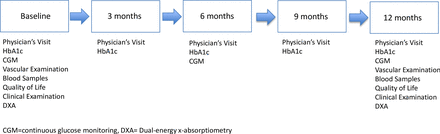
Limitations of our study include the relatively small number of patients, which was based on power calculation related to other than bone health parameters. Additionally, DXA measurements at both time points were available only for 37 out of 47 patients. We therefore acknowledge that the study may be underpowered to detect modest but still clinically relevant associations. Second, 12-month follow-up may be too short to detect significant changes in measures of bone health in patients with T1D. Third, DXA provides a two-dimensional analysis of targeted bone regions and does not provide information on bone geometry or density in different bone compartments. Thus, the use of DXA may have limited our ability to detect subtle or compartment-specific skeletal changes related to poor glycemic control. The use of pQCT in addition to DXA would have brought more detailed information on skeletal health. Fourth, as mentioned above, AGE measurement from blood samples may be inadequate. Further, it is unclear which AGE measure best correlates with bone health in humans.34 We used MG-H1, which has previously been shown to correlate with osteocalcin levels, but more specifically in obese individuals.35 A previous study in adults with T1D indicated an association of pentosidine with bone fractures,33 and another study indicated non-carboxymethyllysine (CML) to associate with microvascular complications in T1D,36 thus both pentosidine and CML could have been better AGEs to be used in the present study as well. Additionally, each patient wore the CGM device for only 6 days, as the study was conducted between 2015 and 2018, when the 2-week wear period had not yet been established as the golden standard. Finally, physical activity, a potential determinant of bone accrual particularly at weight-bearing sites, was not assessed. This limits interpretation of the observed site-specific and sex-specific differences in BMD changes.
In conclusion, adolescents with poorly controlled T1D had lower DXA-derived BMD z-scores compared with the reference population, but no association was found between bone health and markers of long-term dysglycemia, HbA1c, CGM parameters, or glycemic load. Vertebral fractures were absent, arguing against increased risk of childhood osteoporosis. In longitudinal analyses, circulating IGF-I was positively associated with BMD accrual. Contrary to previous hypotheses, circulating AGE marker MG-HI was not correlated with bone mineral accrual, although serum AGE levels may not fully reflect bone tissue accumulation, and other AGEs may have a stronger impact. Study strengths include its longitudinal design, comprehensive skeletal assessment, and advanced glycemic markers, while limitations include a small sample size, short follow-up, and reliance on DXA alone. Future research should explore alternative AGEs and use more sensitive bone imaging to better understand skeletal fragility in T1D.
Leave a Reply