
Study population
The UK Biobank is a population-based prospective cohort study, consisting of more than 500,000 adults from England, Scotland, and Wales. Participants completed touchscreen questionnaires, verbal interviews, and physical measurements, as well as provided biological samples. The study design and other detailed information on the UK Biobank have been fully illustrated in previous studies.18
Participants with baseline diabetes (type 2 diabetes, type 1 diabetes, and gestational diabetes) were identified according to the algorithm developed by the UK Biobank, which incorporates multiple aspects of information such as self-reported medical history and medication.19 In this study, we excluded participants with baseline diagnoses of type 1 diabetes, gestational diabetes, liver diseases, or alcohol/drug use disorders, and those with missing values of exposure variables. The liver diseases and alcohol/drug use disorders were defined according to the International Classification of Diseases (ICD) codes provided by the Expert Panel Consensus statement20 and relative reference (online supplemental table S1).7 Finally, 307,688 participants (13,380 with type 2 diabetes and 294,308 without diabetes) were included in this study (online supplemental figure S1).
Before enrollment, all participants gave consent in writing form.
Assessment of risk factors
Information on risk factors was collected at baseline through self-report, physical measures, or biochemistry assays. Risk factors were selected based on clinical guidelines and management recommendations for diabetes care and defined based on guideline-recommended ranges9 10 and previous studies21–24: diet (meeting at least 5 of 10 intake requirements for fruit, vegetable, fish, processed meats, unprocessed meats, whole grains, refined grains, vegetable oils, dairy, and sugar-sweetened beverages), smoking status (non-current smokers), alcohol consumption (no more than 14 g/day for women and 28 g/day for men), exercise (at least 150 min/week of moderate activity or 75 min/week of vigorous activity), sedentary behavior (less than 4 hours/day of television watching), BMI (20–25 kg/m2), HbA1c (less than 53 mmol/mol), BP (less than 140/90 mmHg), and LDL-C (less than 2.6 mmol/L). Details on the assessment of these risk factors are shown in online supplemental tables S2 and S3.
Ascertainment of outcomes
The outcomes of this study were severe MASLD (hospitalization or death due to MASLD or metabolic dysfunction-associated steatohepatitis)24 and major adverse liver outcomes (MALO, a composite of compensated or decompensated liver cirrhosis, liver failure, hepatocellular carcinoma, and liver transplantation).7 Specifically, the outcomes were identified on the basis of hospital inpatient records through ICD-10 and ICD-9 codes. The specific ICD codes for severe MASLD and MALO refer to the Expert Panel Consensus statement20 and relative reference (online supplemental table S1).7 The follow-up time for each participant was calculated from the baseline to the date of severe MASLD or MALO diagnosis, date of death, date of loss to follow-up, or the end of follow-up (20210930), whichever came first.
Assessment of covariates
Sociodemographic characteristics were included as potential confounders in this study: age (years), sex (male or female), ethnicity (white British or others), Townsend Deprivation Index (continuous variable; a lower score is indicative of higher socioeconomic status), and educational attainment (college/university degree or other qualification).
Statistical analysis
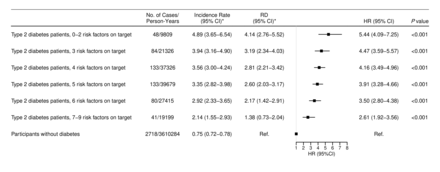
To ensure balanced group sizes and statistical robustness, patients with type 2 diabetes were categorized into six groups according to the number of risk factors within the recommended ranges (0–2, 3, 4, 5, 6, 7–9).14 25 Participants without diabetes were seen as the reference group. Baseline characteristics of these seven study groups were shown as n (%) for categorical variables, mean (SD) for normally distributed continuous variables, and median (IQR) for non-normally distributed continuous variables. Differences between groups were tested by the χ2 test, analysis of variance, and the Kruskal-Wallis test, respectively.
Cox proportional hazards models were applied to estimate the associations (expressed as HRs) between the number of risk factors on target and severe MASLD and MALO among patients with type 2 diabetes, compared with participants without diabetes. The Schoenfeld residual method was used to test the proportional hazards assumption, and no violation was detected. All analyses were adjusted for baseline age, sex, ethnicity, Townsend Deprivation Index, and educational attainment. The percentage of missing values for each covariate was less than 1% and multiple imputation was employed to fill these missing values. To quantify observed disease frequencies, we calculated the incidence rates and absolute rate differences per 1000 person-years of severe MASLD and MALO across study groups, and estimated their 95% CIs using Poisson regression.14 26 27 Furthermore, to explore the proportion of patients with severe MASLD and MALO out of the participants with type 2 diabetes who could theoretically be avoided if all participants with type 2 diabetes maintained seven to nine risk factors on target at baseline, we calculated the population attributable fraction (PAF) under the assumption of a causal relationship.25 28 The PAF values were estimated using the well-validated AFcoxph function from the AF package, which has been widely adopted in similar studies.25 29
We also examined the association of each risk factor with the occurrence of severe MASLD and MALO among patients with type 2 diabetes. The Cox models were adjusted for age, sex, ethnicity, Townsend Deprivation Index, educational attainment, diabetes duration, and diabetes medication use. Additionally, the relative importance of these risk factors was measured by the R2 values of the Cox regression models, using coxphERR function of R software.30 31 The R2 essentially quantifies the proportion of independent contribution of a risk factor to the overall explanatory power of the model, reflecting the relative importance of that variable in explaining survival risk variation.
Analyses among patients with type 2 diabetes were performed with stratification by age (≤60 or >60 years), sex (female or male), educational attainment (college/university degree or other), diabetes duration (<5 or ≥5 years), and diabetes medication use (only oral medication pills, insulin or others, or neither). Interactions between the score of risk factors on target and stratified factors on the risk of severe MASLD and MALO were examined by the likelihood ratio test.
Several sensitivity analyses were performed to test the robustness of our results. First, participants who were diagnosed with severe MASLD or MALO within the first 2 years after recruitment were excluded to reduce potential reverse causation. Second, competing risk models were employed with death regarded as a competitive event. Third, considering the varying degrees of association of different risk factors with severe MASLD and MALO, we constructed a weighted score of risk factors and examined its association with disease outcomes.25 Fourth, analyses were repeated by sequentially excluding each of the nine risk factors. Fifth, different cut-off values for BMI (20–30 kg/m2), HbA1c (less than 48 mmol/mol), BP (less than 130/80 mm Hg), and LDL-C (less than 1.8 mmol/L) were used. Sixth, we additionally included sleep duration (7–8 hours/day was recommended)15 and albuminuria (absence of albuminuria was recommended)14 as additional risk factors, which may be related to diabetes care and liver diseases.9 16 32 33 Seventh, multiple imputations with chained equations were applied to assign missing values of exposure to test the influence of missing data. Finally, the reference group was defined as participants without diabetes who had up to three risk factors on target, four or five risk factors on target, and six to nine risk factors on target, respectively.
All statistical analyses were performed using R V.4.3.0. A two-sided p<0.05 was considered statistically significant.
Leave a Reply